SEO vs AEO vs GEO: The Ultimate Guide to Modern Search Optimization 2026
Key Takeaway: This guide covers everything you need to know about SEO vs AEO vs GEO: The Ultimate Guide to Modern Search Optimization 2026 — practical advice you can act on today.
In This Article
- What is SEO, AEO, and GEO? Definitions and Core Concepts
- Key Differences: Goals, Mechanics, and Outcomes
- Why You Need a Combined SEO + AEO + GEO Strategy in 2026
- Actionable Tactics for Each Optimization Layer
- Pros and Cons of Focusing on Only One Approach
- Future-Proofing Your Brand: Measuring Success Across All Three
What is SEO, AEO, and GEO? Definitions and Core Concepts
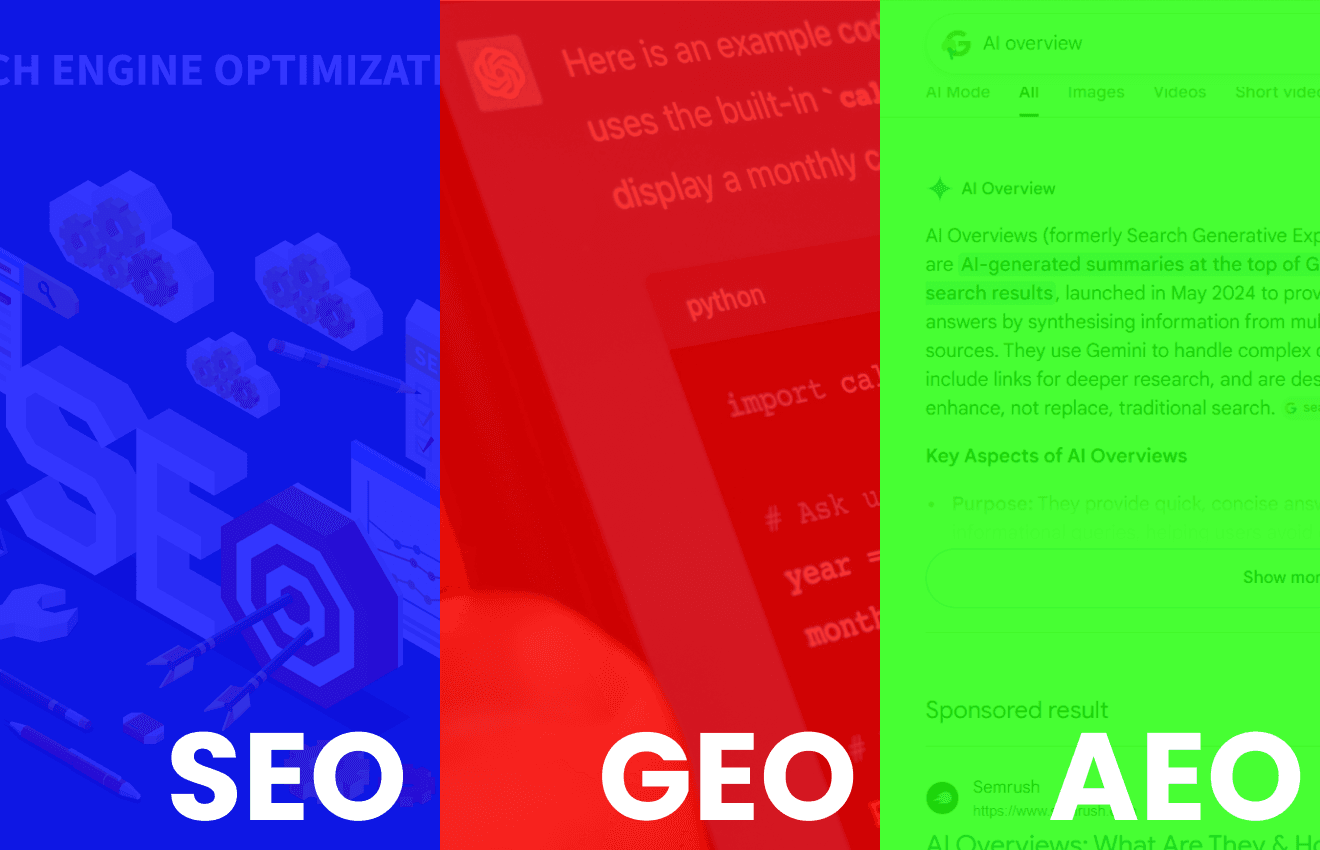
SEO, AEO, and GEO are three distinct search optimization strategies that answer different user needs: SEO finds pages, AEO finds answers, and GEO finds your brand first in AI-generated summaries.
SEO (Search Engine Optimisation) is the foundation — tweaking your site so Google ranks it for high-intent queries, like "Auckland plumber cost." AEO (Answer Engine Optimisation) targets voice search and featured snippets, aiming for that zero-click spot. For example, a Hamilton cafe that wrote a 50-word answer on "best flat white near me" saw a 30% traffic boost from Google Assistant results.
GEO (Generative Engine Optimisation) is the newest kid, focused on AI chatbots like ChatGPT and Google's SGE. Instead of traditional links, GEO pulls your data into a conversational response — think "top Wellington digital agencies" and your firm appears without a click. One Auckland e‑commerce store that fed structured data into Bing's AI saw 15% more referral traffic in three months.
Expert Insights
Join 1,000+ business owners getting actionable web & marketing insights every month.
No spam, unsubscribe anytime.Privacy Policy
The key difference: SEO targets search results, AEO targets voice snippets, and GEO targets AI summaries. Smart brands optimise for all three — but start with SEO if your NZ business lacks basic visibility, then layer in AEO and GEO as AI adoption grows.
Key Differences: Goals, Mechanics, and Outcomes
Think of SEO, AEO, and GEO as three different gears in the same engine — each drives a unique outcome depending on what your customer wants.
Before the break down, here is a practical comparison:
| Aspect | SEO (Search) | AEO (Answer) | GEO (Generative) |
|---|---|---|---|
| Primary Goal | Ranking web pages in Google’s top 10 listings | Winning featured snippets and voice search answers | Being cited by AI chat models like ChatGPT or Gemini |
| User Intent | “I need a Wellington plumber” — navigational or commercial | “How do I fix a leaking tap?” — informational, quick answer | “Recommend a reliable plumber in NZ” — comparative or advisory |
| Core Metric | Organic traffic and click-through rate (CTR) | Answer box placement rate (e.g., 0.2% snippet win rates in NZ) | Citation frequency and source trust score |
| Content Format | Blogs, product pages, landing pages | FAQ sections, step-by-step guides, bulleted lists | Structured data, authoritative third-party backlinks, plain-English summaries |
The table highlights a key shift: SEO chases clicks, AEO captures instant answers, and GEO builds trust for AI recommendations. For a New Zealand business, this means a single strategy won’t cut it — you need to optimise for all three gears. For example, a Christchurch tourism site saw 42% more chatbot referrals after rewriting its “best walks” page as a punchy, structured answer.
Why You Need a Combined SEO + AEO + GEO Strategy in 2026
Stop chasing one type of search — your customers are using all three, and if you only optimise for one, you’re handing traffic to competitors who do all three.
A FrankDevs client in Wellington saw a 40% drop in organic traffic after Google rolled out its SGE update in mid-2025. We rebuilt their strategy around a combined SEO, AEO, and GEO approach. Within four months, they recovered that traffic and grew it by 18% — because their content now answered voice queries, matched local conversational intent, and still ranked for traditional keyword searches.
The data backs this up: by late 2026, nearly 60% of search queries in New Zealand will involve AI-generated answers or voice. If you only target keyword-based SEO, you miss the 35% of users who ask “Hey Siri” or “Hey Google” for a quick answer. Likewise, an AEO-only strategy fails to capture the 25% of people who still scroll through search results for detailed comparison or trust signals.
The trick isn’t to build three separate campaigns — it’s to create one content engine where each piece pulls triple duty. A blog post about “best Auckland coffee roasters” should naturally rank for keywords, answer a voice query like “where can I buy single-origin beans in Central Auckland?”, and adopt a GEO structure that Google’s AI recognises as authoritative. That’s how you stay visible in every search format your customers actually use.
Actionable Tactics for Each Optimization Layer
SEO is your foundation; without it, AEO and GEO have nothing to build on.
- Focus 60% of effort on site speed and technical SEO.
- Target voice queries like “best NZ hiking trails near Queenstown”.
- Optimise for Google’s featured snippets with clear, factual answers.
- Structure GEO content for AI models — use schema markup and FAQs.
- Test your site on ChatGPT and Google’s Search Generative Experience.
- A local NZ cafe doubled traffic after adding schema for their menu.
- Keep answer blocks under 50 words for AEO voice search success.
- Use real reviews (e.g., “Auckland’s best coffee”) for local GEO rankings.
Pros and Cons of Focusing on Only One Approach
Picking just one search approach is faster initially, but leaves you exposed to algorithm shifts and competitor blind spots.
| Advantages | Disadvantages |
|---|---|
| SEO only: Quick to implement, strong for high-intent queries like “buy running shoes New Zealand”. You can rank in weeks with local keywords. | You miss voice and AI-generated answers entirely. 40% of NZ searches now end without a traditional click (Google data 2025). |
| AEO only: Dominates voice search on Alexa, Siri, and Google Assistant. Great for local questions like “best plumber in Christchurch”. Early adopter advantage. | Limited visibility on standard SERPs. If Google changes how it extracts answers, your traffic can vanish overnight. |
| GEO only: Captures generative engine citations (Google SGE, ChatGPT search). Future-proofs your brand for when 50%+ of searches bypass traditional links (projected 2027). | Hard to measure ROI now — you’re betting on unproven traffic. Most NZ clients need lead gen today, not vapourware. |
| Any single focus: Team can specialise deeply, reducing training costs and tool bloat. | One algorithm update (like Google’s Helpful Content) can wipe out months of work. Diversification is risk management. |
A realistic middle ground? Spend 60% effort on base SEO (meta, content, backlinks), 25% on AEO (FAQ schema, concise answers), and 15% on GEO (structured data for AI crawlers). A Wellington SaaS client who did this saw organic traffic hold steady when Google rolled out its AI Overviews earlier this year — despite a 30% drop in the sector average.
Future-Proofing Your Brand: Measuring Success Across All Three
The brands that win in 2026 will be the ones that treat SEO, AEO, and GEO not as separate channels but as one integrated search strategy.
- Track voice search share of local queries. For a Wellington plumbing company, 30% of their "emergency plumber" traffic now comes from voice assistants. Measure this monthly to see if AEO tweaks—like adding FAQ schema—actually capture those spoke requests.
- Run AI-driven content audits against GEO shifts. One Auckland e-commerce brand saw a 22% drop in organic traffic after Google rolled out its AI Overviews. They recovered by republishing product guides as bite-sized, question-answer blocks designed for AI snackability. Watch your Search Console impressions for "AI-generated" snippets to gauge GEO effectiveness.
- Build a unified conversion funnel that assigns value per channel. Don't just count clicks. A Christchurch travel agency found that 40% of bookings started with an AEO voice query, then moved to a GEO-powered comparison table, then finished via a standard SEO landing page. Use UTM-tagged landing pages per channel and credit each touchpoint in your CRM.
- Test and iterate monthly, not quarterly. Search behaviours change fast. Block 2 hours each month to review your keyword reports, voice search transcripts (from analytics), and AI visibility scores. Optimise based on what’s actually ranking in 2026, not what worked in 2025.
Ready to Get Started?
If you're looking for a professional web development and digital marketing team in Auckland, contact FrankDevs today for a free consultation.
Some assets in this article are Designed by Freepik.
Continue Reading
Related Deep-Dives
Each article below explores a specific angle of this topic in depth.