
AI Website Builder vs WordPress: A Practical Comparison from a Technical Perspective
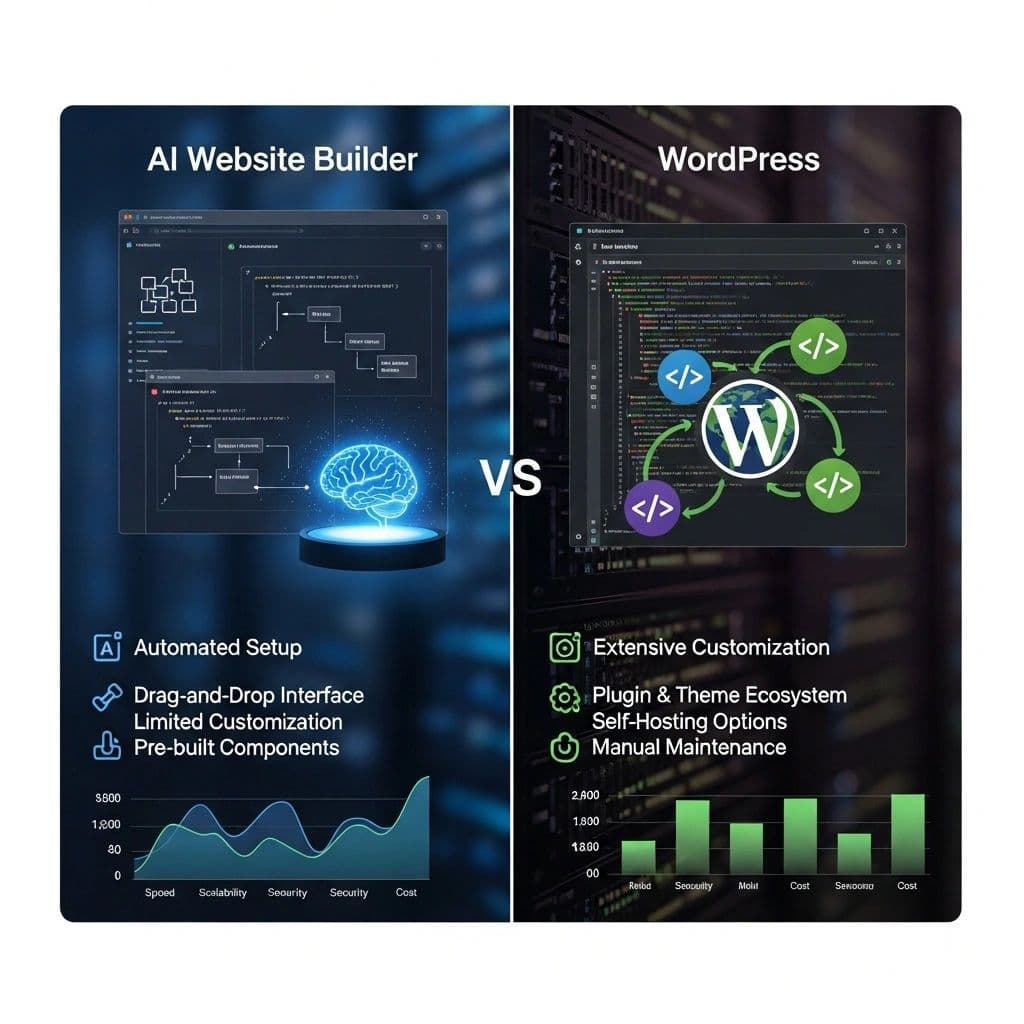
AI Website Builder vs WordPress: A Practical Comparison from a Technical Perspective
The way websites are built is undergoing a noticeable transformation.
AI-powered website builders promise speed, automation, and minimal effort, while WordPress continues to dominate as a flexible and content-driven platform. Although both approaches aim to solve the same problem—building a functional website—their philosophies, technical foundations, and long-term implications differ significantly.
This article examines AI website builders and WordPress from a practical and technical standpoint, focusing on real-world use cases rather than marketing claims.
AI-Generated Websites: Speed and Automation First
AI website builders are designed around a simple premise: reduce decision fatigue and compress the time required to launch a website.
By answering a small set of questions—industry, purpose, tone, and preferred layout—the system generates a complete site structure, visual design, and initial content.
Expert Insights
Join 1,000+ business owners getting actionable web & marketing insights every month.
No spam, unsubscribe anytime.Privacy Policy
From a technical professional’s perspective, this approach is particularly useful when:
- The business domain is unfamiliar
- Content needs to be generated quickly as a placeholder
- The website’s role is primarily informational
AI-generated copy, while often generic, provides a usable baseline. It reduces the friction of starting from a blank page and allows stakeholders to focus on refinement rather than creation from scratch.
WordPress Website Development: Flexibility at the Cost of Effort
WordPress remains one of the most mature and adaptable content management systems available.
Unlike AI builders, WordPress does not attempt to abstract away complexity. Instead, it exposes it—sometimes uncomfortably—through themes, plugins, configurations, and hosting considerations.
Building a WordPress site usually involves:
- Choosing and configuring a theme
- Manually adjusting layouts, typography, and branding
- Installing plugins for SEO, caching, security, and analytics
- Managing updates and compatibility over time
This manual involvement increases the learning curve, but it also unlocks near-limitless extensibility.
WordPress Themes and Manual Operations
Themes are the backbone of WordPress visual presentation, but they often require hands-on work.
Even premium themes rarely work perfectly out of the box. Customization usually includes:
- Page builder configuration
- CSS or layout adjustments
- Performance tuning
- Mobile responsiveness checks
For non-technical users, this can feel overwhelming. For experienced developers, however, it provides fine-grained control that AI builders cannot yet match.
WordPress as a Blogging and Content Publishing Platform
One area where WordPress still excels is content publishing.
Its native blogging functionality is deeply integrated into the platform, offering:
- Structured post types
- Categories and tags
- Editorial workflows
- Long-term content scalability
For websites that rely on ongoing content updates—blogs, news sections, educational resources, or SEO-driven content strategies—WordPress offers a proven and robust foundation.
AI website builders, by contrast, often treat blogs as secondary features or omit them entirely.
AI Website Builders Are Best for Static Content Sites
AI-generated websites are most effective when:
- The number of pages is fixed
- Content does not change frequently
- There is no requirement for dynamic publishing (such as blogs or news feeds)
Typical examples include:
- Company profile websites
- Landing pages
- Portfolio or showcase sites
- Event or campaign microsites
In these scenarios, speed and visual coherence often matter more than long-term content management.
AI Content Generation from a Technical Practitioner’s Viewpoint
From a developer or technical consultant’s perspective, AI-generated content is particularly valuable when entering unfamiliar industries.
It helps bridge knowledge gaps by:
- Generating industry-specific terminology
- Suggesting service descriptions
- Providing neutral, presentable default messaging
While the content usually requires human revision to achieve depth and authenticity, it significantly accelerates early-stage delivery.
Under the Hood: Framework Choices and SEO Implications
Not all AI website builders are created equal from a technical standpoint.
Some platforms generate websites using React-based Single Page Application (SPA) architectures. While SPAs can offer smooth interactions, they often introduce SEO challenges if not implemented correctly.
Search engines may struggle with:
- Client-side rendering
- Delayed content hydration
- Poor indexability of dynamically loaded pages
More advanced AI builders allow websites to be generated using frameworks such as Next.js.
By leveraging server-side rendering (SSR) or static site generation (SSG), these sites deliver fully rendered HTML to search engines, resulting in:
- Improved crawlability
- Faster perceived load times
- Stronger SEO performance
When SEO is a priority, the ability to choose a Next.js-based output is a critical technical advantage.
Choosing Between AI Website Builders and WordPress
The decision ultimately depends on the website’s purpose rather than trends.
- Choose AI website builders when speed, simplicity, and static presentation are the primary goals.
- Choose WordPress when content scalability, blogging, and long-term flexibility are essential.
Both approaches have their place. Understanding their technical trade-offs allows businesses and developers to make decisions based on strategy, not hype.
Some assets in this article are Designed by Freepik.